Phrase (Basic ㊦ 204)
A volitional decision to do something is made.
Equivalent: Decide to
| (i) Vinformal nonpast | ことに{しる/した} | |
| 話すことに{しる/した} | Someone decides/has decided to talk | |
| 食べることに{しる/した} | Someone decides/has decided to eat |
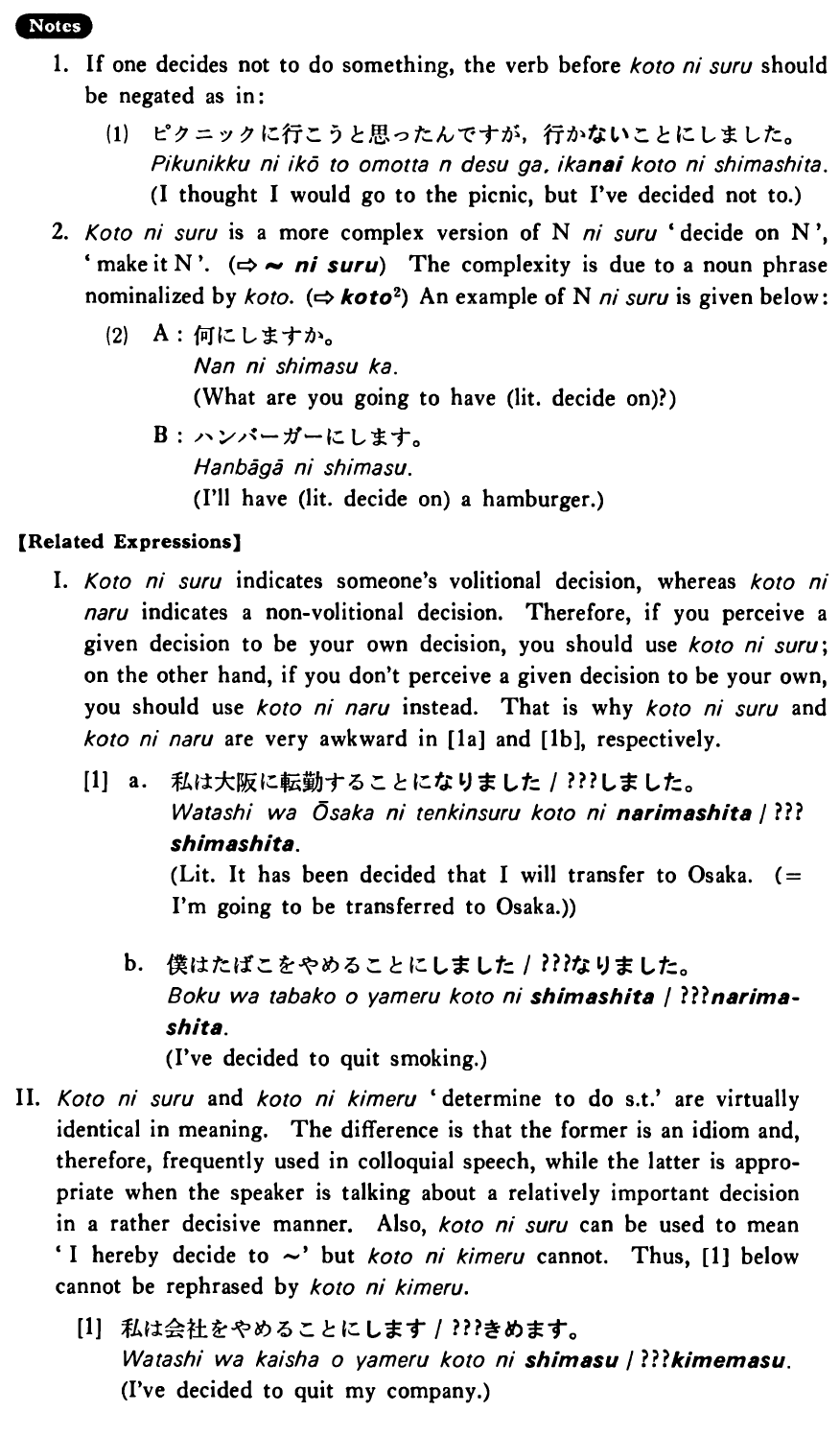
1. If one decides not to do something, the verb before ことにする should be negated as in:
2. ことにする is a more complex version of Nounにする
'decide on Noun', 'make it Noun'. (⇨ にする) The complexity is due to a noun phrase nominalized by こと. (⇨ こと2) An example of Nounにする is given below:【Related Expressions】
I. ことにする indicates someone's volitional decision, whereas ことになる indicates a non-volitional decision. Therefore, if you perceive a given decision to be your own decision, you should use ことにする; on the other hand, if you don't perceive a given decision to be your own, you should use ことになる instead. That is why ことにする and ことになる are very awkward in [1a] and [1b], respectively.[1]
II. ことにする and ことに決める 'determine to do something' are virtually identical in meaning. The difference is that the former is an idiom and, therefore, frequently used in colloquial speech, while the latter is appropriate when the speaker is talking about a relatively important decision in a rather decisive manner. Also, ことにする can be used to mean 'I hereby decide to ~' but ことに決める cannot- Thus, [1] below cannot be rephrased by ことに決める.
[1]